 Türkçe
 English
 Русский
 Deutsch
 Français
 العربية
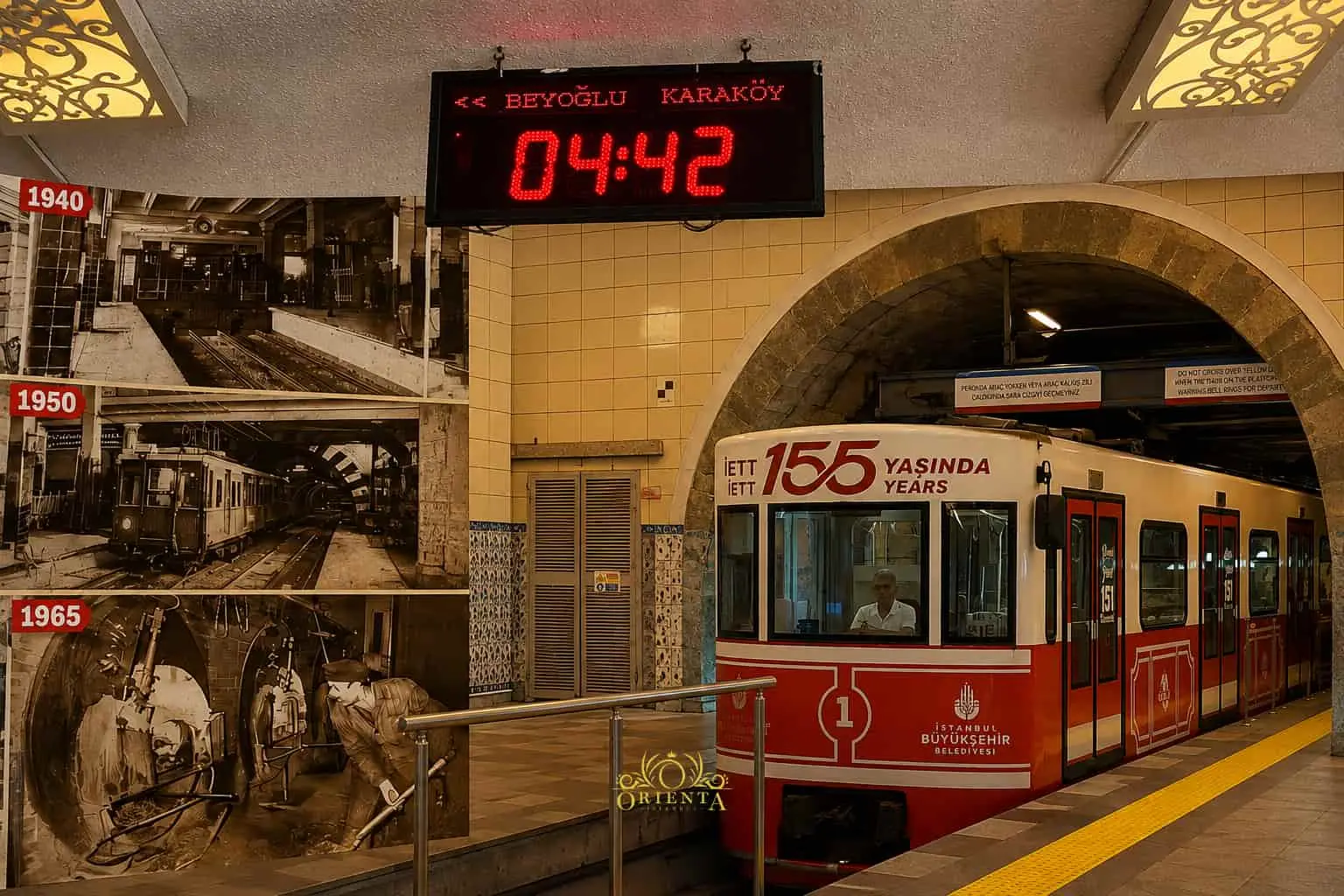
Istanbul’s First Metro: Tünel
With its deep-rooted history, rich cultural heritage, and transportation structures that have evolved from past to present, Istanbul is one of the world’s most remarkable cities.
One of the places where you can experience this historic urban fabric most closely is Tünel, Istanbul’s First Metro, connecting Karaköy and Beyoğlu.
This historic line is more than just a means of transportation. Connecting Karaköy, known for its historic bank buildings, with the streets of Beyoğlu leading to İstiklal Avenue and the steep slopes overlooking the Bosphorus, Tünel acts as a bridge through time between some of Istanbul’s most vibrant and distinctive neighborhoods.
With accommodation options in central locations such as Beyoğlu, Beşiktaş, and Kadıköy, Orienta Istanbul Tourism places you within easy reach of this historic route and many of Istanbul’s most iconic attractions.
The History of Istanbul’s First Metro: A Project Born from a Steep Hill
The story of Istanbul’s First Metro, Tünel, is closely connected to the early development of underground urban railway transportation. The world’s first underground railway opened in London in 1863. In Istanbul, the story of Tünel began when French engineer Eugène-Henri Gavand visited the city in 1867.
During his visit, Gavand observed heavy pedestrian traffic between Galata, one of the city’s most important commercial centers at the time, and Beyoğlu, a center of social life. People traveling between these two areas had to use the steep Yüksek Kaldırım slope.
Recognizing this difficulty, Gavand developed a railway project that would connect Galata and Beyoğlu underground, making transportation between the two districts significantly easier.
Gavand’s proposal was reviewed by the Ottoman Council of State and approved by Sultan Abdülaziz. The necessary concession was granted through an imperial decree dated June 10, 1869.
On November 6, 1869, a contract was signed between Minister of Public Works Davut Pasha and Gavand. According to the agreement, the project would be carried out without any financial support from the state treasury, with all costs and risks assumed by the concession holder. In modern terms, this could be considered an early example of a build-operate-transfer model.
The agreement required construction to be completed within 30 months. The double-track railway was planned to have a total width of 7.70 meters, while 1.5% of its revenue would be paid to the state. The concession period was set at 42 years, and the government retained the right to purchase the railway after 15 years.
Completed with the labor of hundreds of workers, Tünel officially opened on January 17, 1875, with a grand ceremony.
Interestingly, Eugène-Henri Gavand, the engineer who originally developed the project, did not attend the opening. He had been removed from his position by the company before the project was completed. The total cost of Tünel was recorded as 4,125,554 francs.
The Impact of Istanbul’s First Metro on Everyday Life
After opening in 1875, Tünel quickly attracted significant interest from Istanbul residents.
During its early years, first- and second-class ticket options were available. Children under the age of five traveled free of charge, while soldiers and passengers wearing official uniforms were eligible for discounted fares.
In its first 14 days of operation, Tünel carried approximately 75,000 passengers. As interest continued to grow, passenger numbers reached around 111,000 in February and 127,000 in April.
Following a reduction in ticket prices, the number of passengers increased to approximately 225,000 in June. These figures demonstrate how quickly Istanbul’s First Metro became an important part of the city’s public transportation network.
Technical Features of Istanbul’s First Metro
Designed by French engineer Eugène-Henri Gavand, Tünel follows a route specifically developed to overcome the significant elevation difference between Karaköy and Beyoğlu.
The railway is approximately 550 meters long. It begins near sea level in Karaköy and reaches Beyoğlu at an elevation of approximately 63 meters.
When it entered service in 1875, Tünel was designed with an operating principle similar to a funicular or elevator system. During its early years, the carriages were moved using a cable system powered by large steam engines located on the Beyoğlu side.
Opened 12 years after the London Underground, Tünel is one of the world’s oldest underground urban rail systems and holds an important place in Istanbul’s transportation history as Turkey’s first metro.
After operating with steam-powered machinery for many years, the line came under public administration in 1939. Between 1968 and 1971, Tünel underwent extensive modernization and was transformed into an electric, rubber-wheeled system.
Istanbul’s First Metro Today
Today, Tünel continues to operate between Karaköy and Tünel Square, located at the beginning of İstiklal Avenue.
With only two stations and a short route, the journey takes just a few minutes. Despite its short distance, traveling on the historic Tünel offers a distinctive experience.
With its nostalgic atmosphere and historical character, Tünel continues to attract both Istanbul residents and local and international visitors. Much like its first journeys in 1875, it still offers a short but memorable connection between Karaköy and Beyoğlu, bringing Istanbul’s past and present together.
What Is Within Walking Distance of Tünel?
Located in one of Istanbul’s most central areas, Tünel is within walking distance of many historical and tourist attractions around Beyoğlu, Galata, and Karaköy.
After your Tünel journey, you can continue exploring Istanbul’s historic streets and add some of the city’s most popular attractions to your route.
Galata Tower
One of Istanbul’s most iconic landmarks, Galata Tower is only a short walk from Tünel’s Beyoğlu station. Its central location makes it one of the easiest attractions to combine with a journey on the historic Tünel line.
İstiklal Avenue
With its historic buildings, arcades, shops, restaurants, and cultural venues, İstiklal Avenue is one of Istanbul’s liveliest and most famous streets. Tünel Square is located at one end of the avenue, making it an ideal starting or ending point for exploring İstiklal.
Balık Pazarı
Located near İstiklal Avenue, Balık Pazarı, or the Fish Market, is one of Beyoğlu’s characteristic areas. Its restaurants, traditional flavors, and lively atmosphere make it an interesting stop while exploring the neighborhood.
Karaköy
Home to the lower station of Tünel, Karaköy is one of Istanbul’s most popular neighborhoods with its historic streets, cafés, art spaces, restaurants, and waterfront.
Galataport Istanbul
Located along the Karaköy waterfront, Galataport Istanbul combines Bosphorus views with restaurants, shops, and cultural venues. Its proximity to Tünel makes it another popular destination that can easily be included in your route.
Stay with Orienta Istanbul Tourism
When exploring Istanbul’s historical and tourist attractions, choosing accommodation in Istanbul in a central location can help you make better use of your time in the city.
Orienta Istanbul Tourism offers comfortable accommodation options in Beyoğlu, Beşiktaş, and Kadıköy, providing convenient access to many of Istanbul’s historical, cultural, and tourist attractions.
By staying in Beyoğlu, you can easily explore Tünel, Galata Tower, İstiklal Avenue, and Karaköy. Accommodation options in Beşiktaş and Kadıköy also provide convenient connections to Istanbul’s historical and tourist routes through ferries, buses, and other public transportation alternatives.
To experience Istanbul’s historic atmosphere while enjoying comfortable accommodation in Istanbul, explore the accommodation options offered by Orienta Istanbul Tourism.
Beyoğlu
By staying at Orienta Istanbul Tourism apartments in Beyoğlu, you can easily reach Tünel, one of Istanbul’s most important historic transportation landmarks.
From central locations in Beyoğlu, walk toward İstiklal Avenue and Şişhane to reach Tünel’s Beyoğlu Station. From there, take the historic Tünel line down to Karaköy.
After your Tünel journey, continue exploring some of Istanbul’s most popular attractions, including Galata, Karaköy, and Galataport.
Osman Efendi Apartment
Airbnb Link:
https://www.airbnb.com.tr/rooms/1107077109308458317?viralityEntryPoint=1&s=76
Orienta Istanbul Tourism Website:
https://orientaistanbul.com/tr/mulklerimiz/osman-efendi-apartmani-1
Pala Hayri Apartment
Airbnb Link:
https://www.airbnb.com.tr/rooms/1459953942530771193?viralityEntryPoint=1&s=76
Orienta Istanbul Tourism Website:
https://orientaistanbul.com/tr/mulklerimiz/pala-hayri-apartmani-2
Nil Apartment
Airbnb Link:
https://www.airbnb.com.tr/rooms/1045413530542671833?viralityEntryPoint=1&s=76
Orienta Istanbul Tourism Website:
https://orientaistanbul.com/tr/mulklerimiz/nil-apartmani-2
Beşiktaş
By staying at Orienta Istanbul Tourism apartments in Beşiktaş, you can conveniently reach Istanbul’s First Metro, Tünel, using different public transportation options.
From Beşiktaş, take a bus toward Taksim and reach Taksim Square. From there, walk along İstiklal Avenue to Tünel’s Beyoğlu Station.
Alternatively, take a bus from Beşiktaş toward Karaköy. Once you arrive in Karaköy, board the historic Tünel line and travel directly up to Beyoğlu.
With convenient access to both the Bosphorus and Istanbul’s historic districts, Beşiktaş is also a practical choice for visitors looking for centrally located accommodation in Istanbul.
Enver Apartment
Orienta Istanbul Tourism Website:
https://orientaistanbul.com/tr/mulklerimiz/enver-apartmani-1
Ida Maria Apartment
Orienta Istanbul Tourism Website:
https://orientaistanbul.com/tr/mulklerimiz/ida-maria-apartmani-2
Kadıköy
When staying at Orienta Istanbul Tourism apartments in Kadıköy, you can easily reach Istanbul’s First Metro, Tünel, by using the city’s ferry network.
Take the ferry from Kadıköy Pier to Karaköy. After arriving at Karaköy Pier, a short walk will take you to Tünel’s Karaköy Station. From there, use the historic Tünel line to reach Beyoğlu.
For travelers looking for accommodation in Istanbul while experiencing the atmosphere of the Asian Side, Kadıköy provides convenient access to both local attractions and the European Side.
Tülin Hanım Apartment – Apartment 1
Airbnb Link:
https://www.airbnb.com.tr/rooms/1128735686691914900?viralityEntryPoint=1&s=76
Orienta Istanbul Tourism Website:
https://orientaistanbul.com/tr/mulklerimiz/tulin-hanim-apartmani-1
Moda Köşk
Located in the heart of Moda, this historic mansion offers a distinctive accommodation experience with its nostalgic atmosphere and central location.
The three-story mansion features four bedrooms, two bathrooms, including one with a jacuzzi, and a peaceful balcony. With its spacious layout, Moda Köşk is an affordable accommodation option for both large groups of friends and families.
Airbnb Link:
https://www.airbnb.com.tr/rooms/1282449979582288022?viralityEntryPoint=1&s=76
Orienta Istanbul Tourism Website:
https://orientaistanbul.com/tr/mulklerimiz/moda-kosk